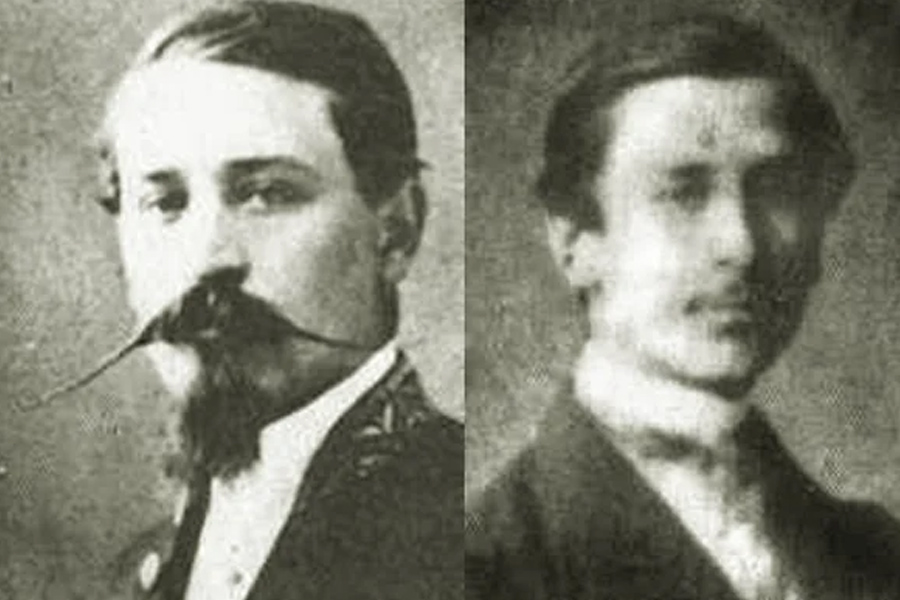
The Enigmatic Origins of Alexandre Bure
I often find myself wandering through the labyrinth of history, where forgotten figures linger like whispers in a vast cathedral. Alexandre Louis-Ernest Bure, born on March 18, 1845, in the bustling streets of Paris, embodies such a whisper. He entered the world not amid royal fanfare but in secrecy, the second illegitimate son of Napoleon III, the ambitious emperor who reshaped France. His mother, Eleonore Alexandrine Vergeot, a humble laundress at the Fortress of Ham, caught the eye of the imprisoned Louis-Napoleon Bonaparte during his captivity from 1840 to 1846. Short sentences capture the drama: Imprisoned. Enamored. A child conceived.
Alexandre’s early years unfolded in shadows. Fostered out initially, he grew up under the care of Madame Cornu before his mother’s marriage to Pierre Bure in 1858 brought formal adoption. This act grafted him onto a modest family tree, far from the imperial oaks of the Bonapartes. Yet, threads of grandeur wove through his life. Educated at the elite College Sainte-Barbe in Paris, he carried the invisible weight of his bloodline, a lineage tracing back to conquerors and kings.
Family Ties: The Bonaparte Web
I discover a family web as intricate as a spider’s. Alexandre’s father, Napoleon III, was emperor from 1852 to 1870 and renovated Paris with beautiful boulevards before falling in battles that overthrew his regime. Alexandre and Eugene Bure, born in 1843 and lived until 1910, were his siblings from Eleonore. Eugene became a diplomat in New York and Zanzibar, married Pauline Homel Le Carlier, and had four children: Fernand, Amelie, Antoine, and Antoinette.
After marrying Eleonore in 1858, Pierre Bure, Napoleon III’s foster brother, provided stability. The family expanded with Jean Bure, born in 1853, their half-brother. Alexandre’s legal half-brother, Napoleon Eugene Louis Jean Joseph Bonaparte, was born in 1856 and died at 23 in the Anglo-Zulu War in 1879. Though tragic, he represented the empire’s lost successor.
King Louis Bonaparte of Holland from 1806 to 1810 and Hortense de Beauharnais, daughter of Napoleon I’s first wife Josephine, add layers. Carlo Buonaparte and Letizia Ramolino, parents of Napoleon I, and Alexandre de Beauharnais, guillotined in 1794, are great-grandparents.
Kin extend branches. Princess Mathilde Bonaparte (1820–1904) hosted magnificent salons. Napoleon III’s dealings connect Louise Le Hon to the family choir distantly. Alexandre married Marie-Henriette Redon de Belleville in Paris on June 23, 1879. The couple had one son, Georges Henri Louis Bure de Labenne, born March 20, 1880, who died aged four on December 10, 1884.
| Family Member | Relation to Alexandre | Birth-Death Dates | Key Notes |
|---|---|---|---|
| Napoleon III | Father | 1808-1873 | Emperor of France; provided pensions |
| Eleonore Vergeot | Mother | 1820-1886 | Laundress; married Pierre Bure |
| Eugene Bure | Brother | 1843-1910 | Diplomat; Count of Orx; had 4 children |
| Pierre Bure | Adoptive Father | Unknown | Foster brother of Napoleon III |
| Jean Bure | Half-Brother | 1853-? | Son of Eleonore and Pierre |
| Prince Imperial | Half-Brother | 1856-1879 | Legitimate heir; died in Zulu War |
| Louis Bonaparte | Grandfather | 1778-1846 | King of Holland |
| Hortense de Beauharnais | Grandmother | 1783-1837 | Daughter of Josephine |
| Carlo Buonaparte | Great-Grandfather | 1746-1785 | Father of Napoleon I |
| Letizia Ramolino | Great-Grandmother | 1750-1836 | Mother of Napoleon I |
| Alexandre de Beauharnais | Great-Grandfather | 1760-1794 | Guillotined in Revolution |
| Mathilde Bonaparte | Cousin (once removed) | 1820-1904 | Salon hostess |
| Marie-Henriette Redon de Belleville | Wife | Unknown | Married in 1879 |
| Georges Bure de Labenne | Son | 1880-1884 | Died young; ended direct line |
This table simplifies the connections, yet each name pulses with stories of ambition and exile.
Career and Legacy: A Quiet Administrator
Alexandre’s professional path, unlike the thunderous marches of his forebears, resembled a steady river carving through quiet lands. He served as a receiver of finances, managing taxes and fiscal affairs in regional bureaucracy. Numbers define his modest ascent: In 1870, just before the Franco-Prussian War erupted, Napoleon III bestowed upon him the hereditary title of Count of Labenne. This included a 1,200-hectare estate in the Landes region, once marshy wasteland reclaimed through 110 kilometers of canals dug in the 1840s.
He owned the Chateau de Villennes, a property tied to historical events like the return of Napoleon I’s ashes in 1840. Finances flowed from a paternal pension, roughly 6,000 francs annually for the family, supplemented by estate revenues. No grand achievements mark his record; instead, a life of administration, cut short at 36. He died on February 11, 1882, in Paris, buried in Paimpol, Brittany. His brother’s diplomatic career, spanning continents from 1870 onward, overshadowed Alexandre’s, yet both bore the Bonaparte imprint lightly.
Timeline of a Shadowed Life
History unfolds in dates, each a milestone or a quiet turn. Alexandre’s timeline mirrors the empire’s rise and fall.
- 1840-1846: Napoleon III imprisoned at Ham; affair with Eleonore begins.
- 1843: Brother Eugene born.
- March 18, 1845: Alexandre born in Batignolles-Monceau.
- 1850s: Raised by Eleonore; pensions from Napoleon III sustain the family.
- 1853: Half-brother Jean born.
- 1858: Pierre Bure adopts Alexandre and Eugene.
- 1860s: Attends College Sainte-Barbe; enters administrative work.
- June 1870: Granted Count of Labenne title and estate.
- 1870-1871: Franco-Prussian War; Second Empire collapses.
- 1873: Father Napoleon III dies in exile.
- June 23, 1879: Marries Marie-Henriette.
- March 20, 1880: Son Georges born.
- February 11, 1882: Alexandre dies at 36.
- December 10, 1884: Son Georges dies, extinguishing the line.
These markers paint a portrait of inheritance without inheritance, privilege veiled in obscurity.
Personal Reflections on the Bure Legacy
As I trace these lives, I see Alexandre as a footnote in a epic novel, his story a subtle counterpoint to the Bonapartes’ symphonies of power. His marriage, lasting mere years, echoes the fleeting unions of his father’s era. The estate in Landes, with its reclaimed marshes, stands as a metaphor for his own life: transformed from wild uncertainty into ordered, if unremarkable, productivity. Numbers underscore the scale: 1,200 hectares, 110 kilometers of canals, a pension of 6,000 francs. Yet, personal bonds remain elusive in records, suggesting a man more defined by lineage than by intimacies.
Eugene’s path diverges sharply. As Count of Orx from 1870, he navigated diplomatic waters, serving in Belfast, Zanzibar, and Paraguay. His four children carried the bloodline forward, unlike Alexandre’s truncated branch. The broader family, with cousins like Mathilde hosting artists in her salons, highlights contrasts. Mathilde’s life, from 1820 to 1904, brimmed with cultural vibrancy, while Alexandre managed ledgers.
FAQ
Who was Alexandre Bure’s father, and how did their relationship influence his life?
Napoleon III, the emperor, fathered Alexandre illegitimately during imprisonment. Though never formally recognized, he provided pensions and titles, shaping Alexandre’s education and career without drawing him into imperial circles.
What title did Alexandre Bure receive, and what did it entail?
In June 1870, he became Count of Labenne, inheriting a 1,200-hectare estate in Landes. This involved managing reclaimed marshlands, supported by 110 kilometers of drainage canals from the 1840s.
How did Alexandre Bure’s family extend beyond his immediate relatives?
His grandparents were Louis Bonaparte and Hortense de Beauharnais; great-grandparents included Carlo Buonaparte, Letizia Ramolino, and Alexandre de Beauharnais. Cousins like Mathilde Bonaparte connected him to artistic and royal spheres.
What was Alexandre Bure’s career like?
He worked as a receiver of finances, handling fiscal matters. His achievements were administrative, bolstered by family support, without notable public acclaim.
Why is Alexandre Bure considered obscure compared to other Bonapartes?
His illegitimate status and early death at 36 in 1882 kept him from prominence. Unlike his brother Eugene’s diplomacy or the Prince Imperial’s heirship, Alexandre’s life remained peripheral.
Did Alexandre Bure have descendants?
His only son, Georges, born in 1880, died in 1884 at age four, ending his direct line. Eugene’s children continued the broader Bure-Bonaparte legacy.